Tag Archive for 'public'

Trusting America’s Lawyers

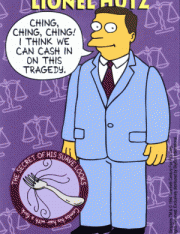
lionel-hutzLawyers get a bad rap.  The public often sees attorneys as conniving opportunistic people who are only out to make a quick dollar by capitalizing on the misery of others.  Ask most people to describe what they think the typical attorney is and you’ll likely get the stereotypical view of the fast-talking imposing dark-suited figure with slicked back hair and a total lack of morals.

The media doesn’t help this image either.  For every Atticus Fitch, there is a multitude of Lilah Morgans.  It’s no wonder then why so many distrust attorneys.  With a reputation like that, who would ever want to deal with one, let alone be forced to hire one to represent them?

Though as bad as a Lilah Morgan can be, what hurts the image of attorneys more are the Lionel Hutzes, the incompetent lawyer who takes your money and does absolutely nothing in return.  This image is in many ways much worst then the evil money-grubbing one.  Chances are most people would rather have an amoral competent attorney than an amoral idiotic attorney.  Couple this fear with the terrifying prospect of actually being involved in a legal dispute where the only way out is to retain a lawyer, and you’ve just described hell.

This fear can be described in two simple words: legal malpractice.  This horrible phrase inevitably lingers in the back of the mind of every person who has hired a lawyer.  Because poor representation not only means you’ll likely lose whatever legal issue you’re involved in, but it also means that you’ll probably have to deal with the expensive headache of cleaning up your lawyer’s mess afterward.  Not to mention the additional nightmare of bringing a new lawsuit against your old attorney.  To some people, this prospect is enough for them to want to represent themselves rather than to retain a lawyer.

But is legal malpractice really something you should be afraid of?  Yes, it is.  But is it really all that likely to occur?  Probably not.

Legal malpractice isn’t as common as the public may think.  Lawyers are subject to constant scrutiny, from the court, their respective state bars in the form of continuing education, and their clients.  Furthermore, the process of becoming a lawyer is no easy task in of itself.  To be admitted into law school takes top grades and a high LSAT score, not to mention the three years it takes just to finish law school.

In fact, the total number of legal malpractice cases handled by LegalMatch.com in California alone is on average 50 percent less then the number of medical malpractice cases handled in just the northern half of California.  This statistic is true almost uniformly across the board.  Personal injury, family law, even wrongful termination cases on average total more in number than legal malpractice cases.  In a sense, it’s much easier to find a good attorney, than it is to locate a good doctor, employer, or spouse!

  • Share/Bookmark

Florida’s Proposed Judicial Protection Act: the Dangers of Secret Chambers

Recently, the Trial Court Performance and Accountability Commission proposed a rule that would limit the public’s access to court information in Florida.  For almost 20 years, the court reporting office at the Palm Beach County Courthouse has furnished the public with recordings of court proceedings for a nominal price.  However, the proposed rule would limit public access to recordings, making them available only after they have been edited and approved by a judge.  The rule would also force people to buy transcripts at an increased cost, as much as $4.50 per page (which translates to hundreds or even thousands of dollars per case!). 

Many Floridians, including lawyers for the First Amendment Foundation in Tallahassee and the Florida Association of Public Defenders, oppose the proposed rule.  Some are concerned that citizens’ access to public information will be severely limited.  And public defenders have complained that they don’t have the budget to buy transcripts, which could unduly prejudice defendants whose cases depend on proving improper courtroom conduct.  Others worry about giving judges full discretion over who has access to public proceedings.  Some lawyers have nicknamed the rule the “Judicial Protection Act, based on the belief that the commission (which is largely comprised of judges) proposed the rule in order to protect their public behavior from being broadcasted to outsiders, including media such as YouTube. 

Proponents of the rule claim that it is intended to protect citizens’ private information, which can be disclosed during courtroom proceedings; for example, bank account and Social Security numbers can be divulged at child support hearings, and microphones can inadvertently pick up confidential conversations between attorneys and clients

It makes sense to me that confidential information about parties should be edited before recordings or transcripts are released to the public.  However, private citizens and attorneys with limited resources must be able to access these materials at a reasonable price.  Additionally, because unfortunately not all judges are upstanding arbitrators of justice, impartial third parties should be the ones editing the materials, not the judges themselves.  Otherwise, the risk of bias is too great, and the purpose of the courts – to provide justice for all – will be lost.

  • Share/Bookmark