Tag Archive for 'vote'

Crooks in Congress: What’s New?

Recently, Alaska Senator Ted Stevens was convicted on seven counts of fraud – and yet the law does not require him to resign from his seat and allowed him to still run for Congress!  It’s of little comfort to me to know that the Senate could decide to censure Stevens (as it’s done to nine other senators in the past) because unfortunately this action would not remove him from office.  It’s a little more encouraging to know that if Stevens were elected (he barely lost), the Senate could expel him by a two-thirds vote; however, it’s not clear whether they would actually vote him out of office . . .

Although four senators before Stevens have been convicted of crimes, two resigned, one died, and one’s term expired before the Senate had a chance to vote on his expulsion.  According to Senate historian, Don Ritchie:  “The Senate is a very collegial body and really doesn’t like to act in that sense.”  As such, they would probably wait for any appeals to be decided before taking action.  So, when will Stevens be considered “convicted”?  A majority of scholars believe a jury’s verdict seals the deal; however, most precedent says a judge’s formal entry of judgment and sentence is definitive. 

At least Stevens couldn’t cast a vote for himself – or anyone – for now since Alaska law denies felons convicted of crimes involving moral turpitude the right to vote until they’re “released from all disability arising under a conviction and sentence, including probation and parole.” 

It baffles me that questions have been raised as to whether Stevens’ crimes involve moral turpitude.  According to the Alaska statute, felonies involving moral turpitude include crimes that are “immoral or wrong in themselves such as murder  . . . extortion, coercion . . . theft, forgery . . . scheme to defraud, falsifying business records . . . bribery, receiving a bribe, perjury, perjury by inconsistent statements . . . and criminal mischief.”  Given that bribery is listed as a crime qualifying under the statute, it seems clear to me that Stevens was engaging in more than enough “moral turpitude” to be covered by the law.

  • Share/Bookmark

The Biggest News You Haven’t Heard About All Day

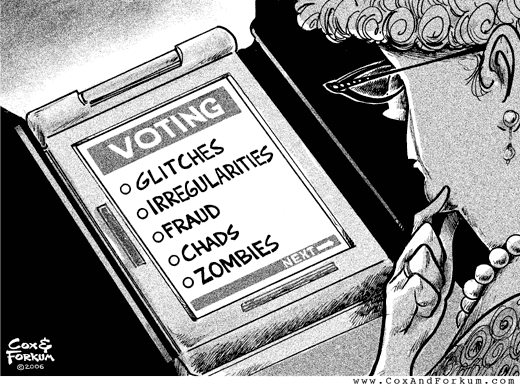
Instead of voting in the next election, why not just put your USB into a voting machine and upload your preferred results? If you live in a state that uses Sequoia Voting System technology, this is not a joke. This can actually happen.

In 2004, the Rutgers Law School Constitutional Litigation Clinic filed a lawsuit against the State seeking de-certification of 10,000 Sequoia AVC machines in New Jersey. It has taken 4 years of discovery and pre-trial litigation for a report to finally be released detailing numerous security flaws in Sequoia’s machines. Unfortunately, the case will not be resolved until sometime after the presidential election.

Computer Science experts analyzing New Jersey’s Sequoia DRE (direct recording electronic) voting machines discovered that voters and election officials alike had the ability to alter votes without leaving behind any evidence of tampering. Votes could be manipulated by physically opening the machines or bypassing unsophisticated security measures on the computers used to count and calibrate them. You can read their report (In a disturbing turn, experts on Sequoia voting machines were recently denied when they asked for permission to view votes being read from the machines this election.)

The voting machines were so easily tampered with that the Judge wanted guards posted at centers where machines were kept before the election, a request denied by the state. Amazingly, New Jersey’s Sequoia voting machines do not even leave a paper trail, which may eliminate several of these security flaws. New Jersey is one of a handful of states using touch screen voting machines that do not print hard copies of every voter’s choices, meaning there is nothing to examine if something goes awry.

How easily can something go awry? According to a report by Computer Science Professors at the University of California Santa Barbara, all it takes is a paperclip or a USB drive. In fact, this is not the first time Sequoia or other DRE machines have been criticized. In 2007, California ordered a full-scale review of every electronic voting system used in the state, which led to sweeping security measures and even decertification of some machines, including those made by Sequoia. Ohio conducted a similar review of its electronic voting systems. The report found all the voting machines currently in use suspect and also recommended their de-certification.

Tampering with votes on DRE machines generally requires surreptitious access to the machines, or one unscrupulous election official. You might be thinking: what else is new? However, these machines were heralded as the new weapon in the fight against election fraud. Billions of dollars was spent on buying the machines, setting them up, and training election officials in their use.

What are we left with after this substantial investment? In some states, an unreliable voting system where there is no guarantee that your vote will be accurately counted. Although no system is perfect, the least we can do is try and move forward, not backward.

  • Share/Bookmark