Tag Archive for 'stevens'

Crooks in Congress: What’s New?

Recently, Alaska Senator Ted Stevens was convicted on seven counts of fraud – and yet the law does not require him to resign from his seat and allowed him to still run for Congress!  It’s of little comfort to me to know that the Senate could decide to censure Stevens (as it’s done to nine other senators in the past) because unfortunately this action would not remove him from office.  It’s a little more encouraging to know that if Stevens were elected (he barely lost), the Senate could expel him by a two-thirds vote; however, it’s not clear whether they would actually vote him out of office . . .

Although four senators before Stevens have been convicted of crimes, two resigned, one died, and one’s term expired before the Senate had a chance to vote on his expulsion.  According to Senate historian, Don Ritchie:  “The Senate is a very collegial body and really doesn’t like to act in that sense.”  As such, they would probably wait for any appeals to be decided before taking action.  So, when will Stevens be considered “convicted”?  A majority of scholars believe a jury’s verdict seals the deal; however, most precedent says a judge’s formal entry of judgment and sentence is definitive. 

At least Stevens couldn’t cast a vote for himself – or anyone – for now since Alaska law denies felons convicted of crimes involving moral turpitude the right to vote until they’re “released from all disability arising under a conviction and sentence, including probation and parole.” 

It baffles me that questions have been raised as to whether Stevens’ crimes involve moral turpitude.  According to the Alaska statute, felonies involving moral turpitude include crimes that are “immoral or wrong in themselves such as murder  . . . extortion, coercion . . . theft, forgery . . . scheme to defraud, falsifying business records . . . bribery, receiving a bribe, perjury, perjury by inconsistent statements . . . and criminal mischief.”  Given that bribery is listed as a crime qualifying under the statute, it seems clear to me that Stevens was engaging in more than enough “moral turpitude” to be covered by the law.

  • Share/Bookmark

Jurors Gone Wild

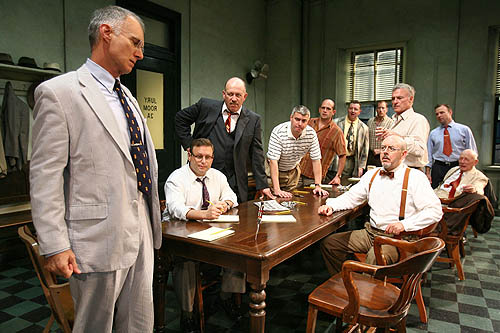
During Senator Ted Stevens’ corruption trial, the jury foreperson urged U.S. District Judge Emmet Sullivan to dismiss one juror, whose “violent outbursts” and disrespectful behavior were disrupting jury deliberations.  In response, Judge Sullivan counseled the jurors to be “courteous and respectful of each other.”  It seems that, at least in this case, a warning was enough to make jurors behave . . .

Judge Sullivan’s reluctance to meddle with jury communications is understandable; after all, a mistrial could be declared if it were found that he exerted unfair influence over the jury.  Yet, if judges adopt overly lax attitudes and fail to remove problematic jurors, other problems can arise. 

For example, in the 1985 case Hernandez v. United States, a trial court for the Eastern District of New York failed to dismiss one juror when the others complained that she was mentally incompetent.  Although the court eventually dismissed the troublesome juror, it did so during deliberations in which she was the sole hold out; as a result, the Second Circuit reversed the trial court, stating that by delaying dismissal, the court created the improper appearance of dismissing to avoid a hung jury. 

During the course of trial, jurors can be dismissed for a variety of reasons, such as incompetence, illness, death, or death of a loved one.  Commonly, dismissal is based on a juror’s inability to remain fair and impartial.  For example, a juror’s impartiality can be tainted if he or she gains access to forbidden media coverage of the trial, even if that access was inadvertent.  In addition, according to the Second Circuit, jurors can be removed based on evidence that they intend to nullify the law.  

Traditionally, jurors have received limited instructions regarding deliberations.  Basically, they’re told: consider the evidence, talk with other jurors about it, but don’t change your opinion just to conform to others’ views or to reach a verdict. 

Are these minimal instructions sufficient though?  It seems to me that a juror could easily mistake dissatisfaction over another juror’s performance (i.e. incompetence) for a disagreement over evidence – an improper ground for dismissal.  

Defense lawyers commonly view tension among jurors as positive, as it ups the chances that they won’t reach a unanimous decision required for a guilty verdict.  Unfortunately for Stevens (and his superstar lawyer, Brendan Sullivan) his jurors, including the especially riotous one, agreed on at least one thing – the senator was guilty.

  • Share/Bookmark