Tag Archive for 'malpractice'

Medical Malpractice, Health Care, and YOU!

medical malpracticeA recent annual check-up got me thinking about healthcare.  Healthcare reform is all the rage right now.  But if you are like me (not a doctor and/or someone with limited medical background) the current debate is often too confusing to follow and you are not sure exactly what to think.

Medical malpractice and tort reform are one such aspect of the debate where you see the convergence of medical and legal issues searching for a solution.  To put it simply, medical malpractice has to do with professional negligence on the part of the care provider that results in some type of harm to the patient.  Because of these potential for errors, medical practitioners carry malpractice insurance to help offset the costs of a potential problem.

Doctors argue that frivolous lawsuits and high jury verdicts have driven up the cost of malpractice insurance to such levels that some doctors refuse to practice the more litigation-ridden areas of their profession or have resorted to conducting costly unnecessary test and procedures to further shield themselves from lawsuits.  While it is true that some attorneys have made millions on medical malpractice suits, many lawsuits bring with them legitimate claims that should continue to have a voice in the American legal justice system.

LegalMatch provides attorneys for both sides of a medical malpractice claim.  The most common situations in which this is found are:

  • When there has been a failure to perform surgery
  • Delay in treatment
  • Failure to properly explain medical procedure or potential side affects
  • Prescription errors
  • Failure to properly diagnose a medical condition
  • Improper treatment

No matter what side of the debate you are on, there are solutions.  As a NY Times article put it, “the goal is not to reduce malpractice lawsuits, it is to reduce malpractice.”  But that is the difficulty: to develop a system that allows providers, doctors, and patients to maintain a trust in the health care system while keeping costs down.  Now we just need to do it.

  • Share/Bookmark

Why You Should Always Check Out Your Lawyers Credentials: A Moral Tale

Being a lawyer is tough.  If you work at a big firm, you have partners breathing down your neck to bill more hours, a seemingly endless pile of mind-numbing documents to review, and a constant sinking feeling that you may be axed on any given day.  Working as a sole practitioner isn’t much better either.  You have to constantly find clients or risk going under, do all your legal research on your own, and deal with something everyone hates: getting your clients to pay for services rendered.

lying attorneyWell, one lawyer has found a way around all of this.  I can’t for the life of me understand how no one figured out before.  Robert P. Mangieri, 68, discovered a way to outsmart all us dolts wasting our time with education and training.  He found that you can just practice law without a license.  It’s so easy and obvious, how did years of attorneys not figure it out sooner?  No need to waste all that money and time on law school or endure countless hours trying to understand how that freakin’ rule against perpetuities doctrine works, just lie and say you did all that crap.  Then all you have to do is open shop, maybe hang up some fake diplomas, and start raking in the money from hapless clients who are too poor to properly check out your credentials.  And the best part is that you don’t have to do any legal research since you’re already lying about your competency or that you’re even legally able to practice law.

I can’t tell guys – was I laying the sarcasm down a little too thick in that last paragraph, or not enough?

As I mentioned in a previous post lawyers in America already have a bad enough reputation without yahoos like Mangieri screwing it up even more for us.  If he had attended law school, he would have learned that lawyers are subject to an incredible number of rules on ethical lawyering, which cover everything from proper notice to guidelines on fees.  Though chances are as a fake lawyer, he probably already knew some of these and chose to ignore them.

Do any of Mangieri’s former clients have a legal recourse against him?  You better believe they do.  Not only is the would-be lawyer being subjected to criminal punishments including grand larceny, impersonating an attorney, and conspiracy to defraud (all of which carry an incredibly light sentence of 4 years – way to deter people federal government!), but he’ll also be open-season to a plethora of tort claims.  The most obvious being fraud and maybe malpractice, but since he’s not officially a lawyer that latter one might not be so obvious.  Though as the saying goes, you can’t get blood from a turnip.  Despite Mangieri duping people into paying him money for services he wasn’t qualified to render, most of his clients weren’t very wealth themselves so Mangieri himself might not be worth so much.

But don’t let Mangieri’s tale fool you into thinking all lawyers are shysters.  Though you should always be sure of your lawyers credentials, according to the latest LegalMatch statistics attorney malpractice cases are among the lowest received.  So don’t be scared to hire a lawyer, just make sure they are actually lawyers first…

  • Share/Bookmark

Trusting America’s Lawyers

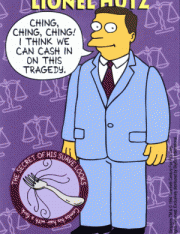
lionel-hutzLawyers get a bad rap.  The public often sees attorneys as conniving opportunistic people who are only out to make a quick dollar by capitalizing on the misery of others.  Ask most people to describe what they think the typical attorney is and you’ll likely get the stereotypical view of the fast-talking imposing dark-suited figure with slicked back hair and a total lack of morals.

The media doesn’t help this image either.  For every Atticus Fitch, there is a multitude of Lilah Morgans.  It’s no wonder then why so many distrust attorneys.  With a reputation like that, who would ever want to deal with one, let alone be forced to hire one to represent them?

Though as bad as a Lilah Morgan can be, what hurts the image of attorneys more are the Lionel Hutzes, the incompetent lawyer who takes your money and does absolutely nothing in return.  This image is in many ways much worst then the evil money-grubbing one.  Chances are most people would rather have an amoral competent attorney than an amoral idiotic attorney.  Couple this fear with the terrifying prospect of actually being involved in a legal dispute where the only way out is to retain a lawyer, and you’ve just described hell.

This fear can be described in two simple words: legal malpractice.  This horrible phrase inevitably lingers in the back of the mind of every person who has hired a lawyer.  Because poor representation not only means you’ll likely lose whatever legal issue you’re involved in, but it also means that you’ll probably have to deal with the expensive headache of cleaning up your lawyer’s mess afterward.  Not to mention the additional nightmare of bringing a new lawsuit against your old attorney.  To some people, this prospect is enough for them to want to represent themselves rather than to retain a lawyer.

But is legal malpractice really something you should be afraid of?  Yes, it is.  But is it really all that likely to occur?  Probably not.

Legal malpractice isn’t as common as the public may think.  Lawyers are subject to constant scrutiny, from the court, their respective state bars in the form of continuing education, and their clients.  Furthermore, the process of becoming a lawyer is no easy task in of itself.  To be admitted into law school takes top grades and a high LSAT score, not to mention the three years it takes just to finish law school.

In fact, the total number of legal malpractice cases handled by LegalMatch.com in California alone is on average 50 percent less then the number of medical malpractice cases handled in just the northern half of California.  This statistic is true almost uniformly across the board.  Personal injury, family law, even wrongful termination cases on average total more in number than legal malpractice cases.  In a sense, it’s much easier to find a good attorney, than it is to locate a good doctor, employer, or spouse!

  • Share/Bookmark

Top Injuries Claimed in Medical Malpractice Lawsuits

medicalmalpracticeI’ve written about our dysfunctional medical malpractice tort system before. In my opinion, attorney’s fees and court costs have a disproportionate stake in the economics of medical malpractice and health insurance in general, as opposed to what really matters: compensating the injured patient and disciplining the guilty doctor(s).

I decided to take a look at the top types of injuries claimed in medical malpractice cases submitted to LegalMatch.com in the past 12 months. Here is what I found:

  • Possibility of future harm: 34%
  • Long term or permanent loss of physical ability: 29%
  • Short term loss of physical ability: 15%
  • Disfigurement or cosmetic injury:  13%
  • Minor injury: 6%
  • No injury: 3%

More than half of the above claims are potential cases of doctor discipline if the claims are taken at face value. This means that in addition to a malpractice claim, the doctor can be subject to punishment by medical licensing boards.

Unfortunately, the stunning reality is that hardly any of the medical malpractice claims won by plaintiffs will result in doctor discipline. According to a study by Public Citizens Health Research Group, of all the medical malpractice payouts between 1990 and 2004, only 5.4% of doctors were subject to discipline. Even worse, of those doctors who had three or more medical malpractice payouts to plaintiffs, only 11.4% were disciplined. 

Why does that matter? Malpractice cases cost everyone money. They raise rates and they clog the tort system. If more doctors were subject to discipline for their negligence in addition to monetary sanctions, perhaps we would see less malpractice lawsuits? It would be a double whammy for doctors; they might take discipline more seriously and they might not be able to continue to practice if their negligence is brought before the proper authorities.

In fact, maybe we can get rid of malpractice lawsuits altogether? Establish some sort of board that can not only discipline doctors but extract compensation from them, or from some general client fund (such as those run by many state bars to compensate clients, like in California).

Certainly all the categories listed above face an uphill climb to get any compensation for the simple reason that litigating malpractice claims is costly. The big winners in our current malpractice system are not patients or the medical profession-they are (surprise surprise) the lawyers. Let’s change the equation and make this about good health and good medicine, not making money.

  • Share/Bookmark

Top Reasons Clients Sue for Lawyer Malpractice

judgethumbsdownPeople don’t like lawyers. They don’t like lawsuits. They don’t like courtrooms. There really is not much about the law or the court system that people really do enjoy. Lawyers that don’t return phone calls, over-bill their clients, or are just downright rude don’t really help the profession very much.

Lawyers who steal money from their clients, miss important deadlines, or just don’t care about the case, on the other hand, disparage the entire legal system. Attorney malpractice is the nasty big elephant in the room whenever there is a dispute between an attorney and her client, no matter how trivial the disagreement may be. In this litigious society of ours, no one is more cognizant of the risk of a lawsuit than lawyers themselves.

Last year, LegalMatch.com received thousands of potential clients seeking a malpractice claim against their former attorney. The majority of these claims were for your usual shenanigans:

  • 12% said they failed to return the client’s money
  • 20% of respondents claimed their attorneys failed to file their lawsuit on time.
  • 29% said they failed to understand the law related to the case

Perhaps most interesting: 37% said their lawyers failed to get the result they had promised them.

Here is a big tip: If you walk into an attorney’s office and they say “If you hire me, I promise you that your case will turn out this way, guaranteed,” run away fast. You might have the easiest case in the world, but no one in this business should ever guarantee anything, ever. Even worse, proving a malpractice case for not getting the result promised would not be very easy.

All malpractice lawsuits are complicated and difficult to win. This translates into a very high bill for your lawyer’s services should you want to pursue a malpractice claim. The best thing you can do to avoid this nightmare is hire a good attorney from the get go. Not just an attorney with the credentials, but an attorney with a good reputation. However, legal matters are often highly personal. It is not easy to just call your friend and spill the beans in order to get a trusted referral. So what else can you do?

There are numerous easy steps you can take to ensure you are hiring a reputable lawyer. For instance, many states display an attorney’s disciplinary record online. In California, every attorney is listed on the State Bar website, and their disciplinary record is at the bottom of the page. You can also request the full discipline record for every attorney from the State Bar in writing. Although not every disciplinary charge is as serious as the next one, each one should be investigated and taken into consideration when you hire your attorney.

Your second resource is a little less obvious but extremely easy: the all powerful Google. Put the attorney’s name in quotes and search away, you may be surprised what you find. A caveat, however: take everything with a grain of salt. Not everyone understands why their case was lost, or why the judge gave them a harsh sentence. It is not always the lawyer’s fault, even though it may seem that way. Also remember that John Smith, Esq. may have the same name as John Smith, party animal. Use your better judgment to weed out the useless or irrelevant information.

Hiring your lawyer is the first big step in your case, and it may be the most important decision you will make on your own. Do it right and do it once.

  • Share/Bookmark