Tag Archive for 'homeowner'

Average U.S. Homeowners Facing Foreclosure Owe $200,000, LegalMatch Data Shows

home-mortgage1LegalMatch data is continuing to shed light on startling facts about the United States Housing Crisis. In the past year thousands of customers from around the country have come to LegalMatch seeking foreclosure attorneys. I decided to look at how much these clients reported owing on their mortgages. Based on analysis of these responses, between now and March 2008, the median amount owed in a foreclosure action was $200,000.

That’s a lot of money to owe on your house. It might also give us a clue at the depth of the current financial crisis.

“Toxic Assets” have become the new buzzword during this financial crunch, just like “weapons of mass destruction” started rolling off everyone’s tongues in 2003. What are these toxic assets? Most of them are convoluted investment packages that represent a hodge-podge of upside down mortgages from around the country. In other words, big mixed-up sacks of worthless investments that no one wants. The total “value” of these toxic assets is unknown, and probably never will be known. (Part of the whole problem was they were never actually worth what everyone thought they were.)

What can be guessed at, however, is how much money mortgagors were owed in 2008, and how much they are now looking at as potential losses before recouping anything in foreclosure sales. (I.e. the loss these toxic assets might represent on balance sheets). To do so we can use two rather modest assumptions: $200,000 median debt-per-household based on LegalMatch data, and the (low-end) estimated total number of foreclosures in the US in 2008, which was 2 million according to CNN. Putting these numbers together, we get a staggering $400 billion in total outstanding debt in the U.S. housing market. That’s quite a lot of money, and that is probably an estimate on the low end.

However, haven’t we spent something like $10 trillion in bailout money so far? Or at least promised that much? Even if my estimate is off by a magnitude of 5, we’ve still spent more than that already. What if we had spent a few trillion simply paying off overdue mortgages? A “trickle-up” economy, as opposed to the old “$@*# rolls down-hill” approach. Almost every day we are bombarded with news about bailout this, bailout that, trillion dollars here, hundreds of billions of dollars there. I haven’t seen any of this money, have you? (Well maybe if you work for AIG).

Now before someone says that is just rewarding people for their own shoddy financial planning, what are we doing for the banks and firms such as AIG? Banks and their enabling financial partners created an artificial market where risky mortgages not worth the paper they were printed on were sold off as if they were written in gold-ink. How is it somehow more appropriate to reward them for their misdeeds and not the taxpayers who are footing the bill anyway? These are the institutions that invested your 401K in your neighbor’s upside-down $1 million McMansion mortgage. If your neighbor stays in his home for the same inflated price he mortgaged it for, at least your home price won’t plummet due to a cramdown or foreclosure sale.

I’m not a financial expert, but I like to play one online. Where am I going wrong with my populist approach?

  • Share/Bookmark

States Hardest Hit by Foreclosures Have Fewer Owner Occupied Homes

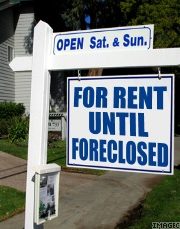
for-rent-until-foreclosedLast year, thousands of clients came to LegalMatch.com seeking foreclosure attorneys. Data compiled from LegalMatch.com databases indicates that California and Florida are first and second in the nation for the total number of homes going into foreclosure. Florida, for instance, accounted for 15% of the total number of people seeking foreclosure attorneys through LegalMatch. Florida, however, only accounts for 8% of the total number of owner occupied homes in the United States, according to latest available data from the U.S. Census Bureau. Many other states are not far behind Florida’s unfortunate ratio. Below are some of the states with similarly disproportionate representation:

% of Total U.S. Foreclosures Reported in 2008 to LegalMatch, By State 

California 21%
Florida 15%
Arizona 3.8%
Maryland 3%
Nevada 1.7%

% of Total Owner Occupied Households in the U.S. (U.S. Census 2007 Estimates)

California 15.2%
Florida 8%
Arizona 2.5%
Maryland 2.5%
Nevada .09%

Not coincidentally, these states also represent a veritable who’s who of states on the list of Top 10 Worst Foreclosure Rates by State.

For all the states doing poorly, there are also states doing well.  New York, for instance represents 9% of the nation’s owner occupied housing units, but only accounts for 3.4% of LegalMatch customers seeking Foreclosure attorneys. Texas is similarly doing well, accounting for 5% of LegalMatch foreclosure respondents, but over 10% of U.S. owner occupied homes.

More analysis may show why these states were hit particularly hard. Some factors may include demand, differing mortgage and foreclosure policies, and vastly different housing markets. California and Florida, for instance, are always roller coaster rides for housing booms and busts. People frequently flock in and out of the states as markets rise and fall. Stay tuned for more analysis as we watch how these numbers shake out over time.

  • Share/Bookmark

Is Fannie Mae the United States’ Landlord?

landlordHomeowners aren’t the only people affected by the foreclosure crisis.  Increasingly, renters who have dutifully paid their rent are being evicted from their apartments because their landlords face foreclosure.  In fact, over the last several months, as many as 70,000 renters have confronted foreclosure-related eviction.

Recently, government-run mortgage finance company Fannie Mae promised to assist tenants by signing new leases with those living in Fannie-owned properties that have been foreclosed.  Under the proposed plan, renters will be granted the option to lease month-to-month on foreclosed properties until the property is resold.  Fannie’s actions mark the first nationwide attempt to save renters caught in the mortgage crises.

While it’s a little disconcerting to see Fannie effectively become our national landlord, the mortgage behemoth’s actions may encourage private lenders to enact such programs; further, lawmakers may be persuaded into enacting more comprehensive relief measures. 

Still, there are potential problems with Fannie’s plan.  First, because the government lacks incentive to maintain rents at market rate, taxpayers may ultimately subsidize below-market rentals.  Second, government may waste taxpayer dollars because it lacks the necessary experience and/or infrastructure to manage these rental properties efficiently.  Third, Fannie’s action prevents these foreclosed properties from being sold on the open market, perhaps exacerbating the housing downturn and economic recession. 

While some states such as Minnesota have passed stricter laws to protect tenants from foreclosure, other states are dragging their heels.  For now, here’s some advice for prospective and current tenants.  Existing tenants should be wary if they suddenly become inundated by advertisements from local bankruptcy lawyers – this indicates the owner may be facing foreclosure.  Prospective tenants should perform a credit check on a property owner.  Also, look out for default or sheriff sale notices posted on the property (and don’t take the owner’s word, if he says things are “under control”). 

Further, check public records online or in your local county records office to see if the owner is failing to make payments or the property is in foreclosure; and while you’re at it, check to see if the owner owes property taxes or association dues – both clues that he may owe mortgage payments as well.  You can research your local foreclosure laws online too.  If you don’t have the time (or patience) to perform such due diligence, at least make sure to watch for a landlord who asks for an unusually high deposit or a number of advance rent payments. 

  • Share/Bookmark

Foreclosure Scammers Finding it Hard to Scam

foreclosure-streetThe U.S. Constitution guarantees representation for criminal defendants who cannot afford to hire their own lawyer.  However, low-income persons facing civil issues must turn to legal aid organizations for help.  Unfortunately, large numbers of homeowners facing foreclosure are not getting the legal assistance they need

Legal aid and private lawyers can often help homeowners avoid foreclosure by negotiating directly with the bank, which most certainly has strong representation.  Legal aid lawyers may also help make the whole process more efficient, as forcibly evicting homeowners is a difficult process. 

Furthermore, the eviction of homeowners causes other problems down the line.  As homes are left vacant and contributing members of a community are banished, neighboring homes fall in value, and local businesses suffer from decreased business.  Therefore, it is in everyone’s interest to make sure homeowners can avoid foreclosure when possible.

States have taken varying approaches to this problem.  Ohio has taken action by implementing free legal aid programs for those facing foreclosure.  While most states offer some sort of resources, homeowners must beware of foreclosure rescue scams.  A new Florida bill intended to protect homeowners from these scams took effect in October, and at least 12 states have enacted similar laws to combat foreclosure scammers.  Only time will tell if these laws accomplish their goals, but in the meantime, homeowners can educate themselves on how to avoid mortgage foreclosure scams.

  • Share/Bookmark