Monthly Archive for December, 2008Page 2 of 5

Fixed But Still Broken

safe-havenRecently Nebraska amended its controversial Safe Haven Law, after it led to alarming consequences reflecting a shortcoming in social services resources.  The law at issue (Legislative Bill 157 or LB 157) permitted parents to leave children up to 17 years old with a state hospital without facing criminal liability.  Since the law went into effect in September 2008, 35 children were abandoned at hospitals across the state:  the majority of them were at least 11 years old, and many of them were afflicted with substantial behavioral conditions.  Furthermore, parents from outside the state traveled to Nebraska to leave their children in the state’s care. 

Nebraska’s amended law, which contains an age limit of 30 days old, now conforms to nationwide norms as well as the purpose behind safe haven laws.  Safe haven laws were enacted to protect young children from immediate danger, not as a way to deal with misbehaving or difficult children.

Questions have been raised as to what will happen to the 35 children who were abandoned during the time when LB 157 was in effect.  Under LB 157, parents cannot be prosecuted for abandonment by leaving their children at a licensed Nebraska hospital; yet, these parents could face other charges and consequences.

For example, if authorities discover that a child was subjected to abuse or neglect before being left with the state, County Attorneys have the choice to file charges.  Additionally, parents who abandoned their children will not be free from all parenting responsibility.  Courts regularly make parents to take parenting classes, participate in therapy, and engage in conflict resolution education – all in an effort to eventually reunite with their children.  Moreover, parents may need to pay child support while their children are in state custody. 

Although Nebraska’s simplest option (a.k.a. LB 157) is no longer available to parents, this is probably a good thing – so long as other resources are offered and made easily accessible.  If not, however, children face the very real prospect of neglect, abuse, or worse.  Some may claim that parents shouldn’t be able to hand off their parental responsibilities to the state, but if social services are not made available, innocent children – and ultimately society at large – suffers.  Therefore, authorities should make parents aware of their options, and not be judgmental when they seek help. 

For now, parents can get state assistance by calling social services, 211, or local United Way organizations.  Parents can also visit their local DHHS office online.  Various resources within the community, including parent support groups, crisis hotlines, faith-based organizations, and treatment centers, can be helpful.  Finally, parents may contact law enforcement after exhausting other options, or if other options are simply not feasible.

  • Share/Bookmark

Undercover Mother

womandisguiseSo your son has been convicted of murder. You believe he is innocent. Do you a) go over the options for appealing the ruling with his attorneys; b) approach you local innocence project or prisoner appeal legal clinic; or c) surreptitiously become involved with one of the jurors and record incriminating evidence of juror misconduct in order to seek a reversal of the conviction? If you did not answer C, shame on you!

After years of openly lobbying for her sons acquittal from a murder conviction, Doreen Giuliano decided to go undercover. She hatched a plan to befriend a juror from her son’s trial and dig up incriminating evidence of juror misconduct in order to overturn the conviction. Mrs. Giuliano became Dee Quinn, a 30 year old professional from California who wore high heels, tight clothes and push up bras. She rented a new apartment, got a tan, lost weight, and dyed her hair blond in an effort to reinvent herself for her daring scheme.

After following two other jurors from the trial to no avail, she became acquainted with Jason Allo. She and Mr. Allo developed a 3 month relationship, which eventually culminated in Mrs. Giuliano hitting the jackpot: a recorded conversation where Mr. Allo admitted to knowing people on the witness list and having a grudge against the gang that Mrs. Giuliano’s son was allegedly involved with. All of these things would have made Mr. Allo unqualified to be a juror, which Mrs. Giuliano claims he even admits on tape. She further claims that Mr. Allo convinced the originally hesitant and skeptical jurors to find her son guilty, a charge Mr. Allo denies.

Will this work? Mrs. Giuliano claims she is looking for a fair trial, not to set her son free at any cost. Certainly, guilt and fairness in criminal justice are separate concerns. Legally a court can overturn a conviction for juror misconduct, but it does not have to. In fact, the convicted carries the heavy burden of proving that juror misconduct was bad enough to warrant overturning the conviction, something courts are loathe to do.

If the court does overturn the conviction, what kind of standard will this set for the future? Will jurors be a little more worried about finding someone guilty? Courts want jurors concentrating on the evidence, not on whether they will be stalked or harmed by those invested in the trial’s outcome. And how did Mrs. Giuliano obtain the private numbers and addresses and names of all the jurors sitting in her son’s trial? The privacy of jurors should be of utmost importance to the courts and to criminal justice in general. Although trials are public hearings, jurors are already scarce enough. Let’s not scare away more jurors from doing their civic duty.

If true, Mr. Allo’s deceit was wrong and unjust. In the end it is doubtful that Mrs. Giuliano’s sting operation will overturn the conviction, however. There were 11 other jurors who thought the defendant committed the crime.

  • Share/Bookmark

For Better or Worse: The “Jewish Marriage Clause” Debate Marches On

jewish-marriage

The Illinois case, In re Estate of Max Feinberg has drawn national attention and raises thorny issues, including how individual freedoms should be interpreted in a post-civil rights world. 

In Feinberg, the Illinois Supreme Court invalidated a trust provision that attempted to disinherit certain beneficiaries if they married persons who were not Jewish.  The court found that the clause violated public policy as discouraging marriage.  Most states hold that provisions discouraging marriage or encouraging divorce violate public policy; however, there’s no consensus on faith-based restrictive clauses.  For example, in Shapira v. Union National Bank, an Ohio court upheld a provision requiring the decedent’s son to marry a Jewish woman within seven years of the testator’s death in order to collect his inheritance. 

According to Restatement Third of Trusts, the Feinberg provision is clearly invalid.  The Restatement specifies that a provision eliminating a beneficiary’s rights to a trust if he marries someone outside a designated religion is void as a violation of public policy.  The Restatement clarifies: trust provisions are generally invalid if they “encourage disruption of a family relationship . . . discourage formation or resumption of such a relationship . . . [or] seriously interfere with or inhibit” the beneficiary’s freedom to divorce or marry “by limiting the beneficiary’s selection of a spouse.”  Given how the provision in question has caused major turmoil within the Feinberg family, it would be invalid under the Restatement.

If Feinberg goes all the way to the U.S. Supreme Court, I hope the Justices will give strong consideration to the fact that the clause does not put the grandchildren’s fundamental right to marry at stake; instead, it merely threatens their inheritance.  Furthermore, a testators’ freedom to dispose of their personal property as they wish has long been respected.  Do we really want to whittle away at this freedom?

  • Share/Bookmark

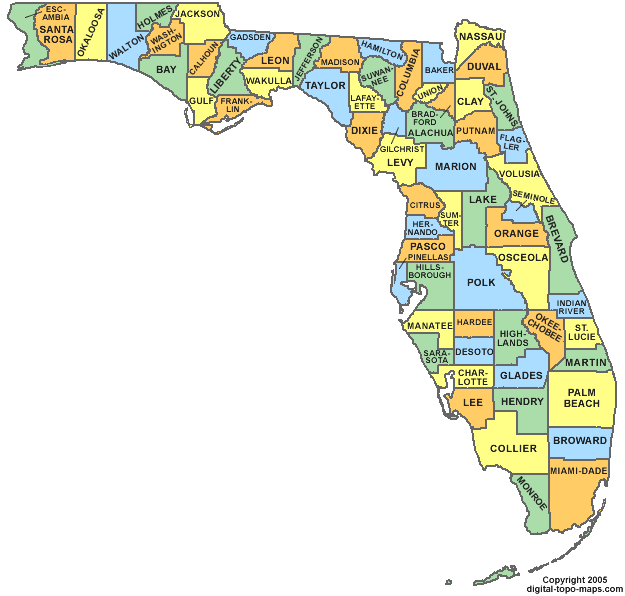
Florida Overturns Ban on Gay Adoption

adoptionA Florida Circuit Court has ruled that homosexuals can now legally adopt children in the state of Florida. (Thanks to How Appealing for the story). Florida was the only remaining state in America that banned people from being adoptive parents based solely on their sexual orientation. The court’s historic decision overturned the law on state equal protection and substantive due process grounds.

A Florida couple sought to adopt two foster care children that had been in their foster care for four years. Even though adoption officials unanimously agreed they were qualified and excellent parents, state law compelled them to decline their application because they were gay. (The particularly alarming facts concerning the children’s prior neglect can be found in the opinion here.)

The couple challenged the law prohibiting their adoption as unconstitutional. They claimed it violated fundamental rights guaranteed to children by Florida law and state equal protection guarantees. The court agreed.

The court recognized that Florida guarantees children permanency in an adoptive home. Uprooting children from foster care parents seeking full adoption can only be done for the best interests of the children. In this instance, denying qualified, loving foster care parents seeking full adoption-for no reason other than their sexual orientation-was not narrowly tailored to serving the best interests of the children. (As opposed to, say, discovering that the foster care parents are actually convicted felons.)

Florida’s ban also lost on equal protection grounds. According to government attorneys, Florida prohibited homosexual adoption to promote the well being of children, lessen the stigmatization of children raised by gay parents, and to uphold society’s “moral interests.” The court made significant findings of fact that none of the government’s stated interests were furthered by banning homosexuals from being adoptive parents. The court furthermore held that legislating moral interests-absent some other legislative purpose-was outside the province of government regulation. (I suspect only the hardcore legal philosophers among you will find this at all controversial.)

The decision is significant for a variety of reasons. First, this comes on the heels of Florida’s recent gay marriage ban. Second, child rearing and the importance of having a “traditional family” is often one of the arguments advanced by those who seek to limit gay marriage. A holding that government discrimination against homosexual parents cannot even pass a rational basis analysis severely undercuts arguments advanced by anti-gay marriage advocates regarding the importance of maintaining the “sanctity of marriage.” On the whole, even though Florida was the sole remaining state prohibiting adoption based solely on sexual orientation, the decision is definitely a positive development in advancing the rights of gays and lesbians in America.

  • Share/Bookmark

The Collapse of Governmental Immunity?

minnesotaRecently, Congress passed a settlement agreement in which $38 million will be disbursed to victims of the 2007 Minneapolis bridge collapse.  Victims who agree to the settlement waive their right to sue the Minnesota government, but retain the right to sue private companies and contractors involved.  Under the agreement, victims who were on the bridge are entitled to up to $400,000, and $12.6 million is reserved in a special fund for those who sustained the worst injuries and losses. 

While this agreement may seem generous, some criticize Minnesota law for granting too much immunity to government officials.  While the state no longer adheres to principles of Sovereign Immunity, statutes and case law have severely circumscribed the ability of private citizens to sue the government; for example, Minnesota’s law limits government liability to $1 million per incident (note, that’s per incident, not per victim). 

Governmental immunity laws serve important public interests, namely they allow state officials such as firefighters and police officers to use their discretion during highly complex and intense situations without fear of reprisal.  Ideally, immunity allows officials to do their best on the job.  However, such laws may also be used to cover up improper practices on the part of officials.  Obviously, the government should not be allowed to shirk its responsibilities to citizens. 

Moreover, private companies should not be left to absorb a disproportionate amount of the blame.  For example, some victims of the bridge disaster sued consulting firm URS Corp., which evaluated the bridge for the Minnesota Department of Transportation. 

Do victim compensation funds like Minnesota’s offer adequate relief, or do governmental immunity laws need reform?  One problem with compensation funds is that it can be difficult to choose which disasters to compensate.  Should public funds be used to compensate tornado victims or those who die in a fire because an inspector failed to identify a violation?  Another problem with compensation funds is that many are riddled with restrictive requirements which limit the amount victims can recover – or prevent them from recovering at all.  Additionally, administrative policies may deplete valuable money, and legislatures have even been known to raid funds

Only time will tell if Minnesota’s fund provides the bridge disaster victims with the help they deserve.  For more information about applicable Minnesota law, visit: LawMoose.

  • Share/Bookmark